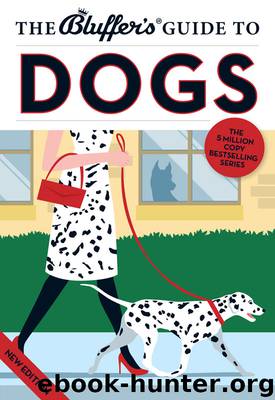
The Bluffer's Guide to Dogs by Simon Whaley
Author:Simon Whaley
Language: eng
Format: epub
Publisher: Bluffer's Guides
HEALTH AND SAFETY
Dogs would be so much more relaxed if veterinarians didn’t call their places of work ‘practices’. If vets need guinea pigs to practise on, then dogs would much rather that particular job was left to the guinea pigs. Veterinary practices have health implications for humans, too. Most vets’ bills are capable of causing stroke or coronary thrombosis.
TABLETS
Dogs that are prescribed tablets enjoy playing the avoidance game. Humans don’t, and it usually takes three steps to get a dog to ingest a pill:
Step 1 Using two hands, one human will hold open the dog’s top and bottom jaws as wide as possible. A second human will throw the tablet into the back of the dog’s mouth. The dog will use their tongue to flick the tablet back across the kitchen floor. The excess saliva produced during this process means the tablet has probably begun to disintegrate and a second attempt is therefore impossible.
Step 2 The human hides the tablet in amongst the food in the dog’s dinner bowl. With their exceptional sense of smell, dogs detect this subterfuge and simply eat around the tablet.
Step 3 Finally, after two days of trying, the owner will take a piece of cheese, wrap it around the tablet and give it to the dog, which it will happily swallow. For some strange reason, owners always go through steps 1 and 2, when it would be simplest to go straight to step 3.
PLASTIC COLLARS
Dogs that are recovering from surgery are often given protective collars in the shape of cones to wear to prevent them irritating stitches or wounds. This isn’t always comfortable for the dog, because it interferes with their ability to hear and smell. It also prevents them attending to that part of their anatomy which they devote more time to than anywhere else. These days it is possible to buy inflatable collars which are supposed to do a similar job, even if they do have the effect of making the dog look like an extra from an Elizabethan restoration drama.
INJECTIONS, VACCINATIONS AND BOOSTERS
Even the healthiest dog can’t escape a visit to the vet. During the first few weeks of life, puppies are inoculated against various diseases such as canine distemper, hepatitis, parvovirus, leptospirosis and sometimes kennel cough. These vaccinations need to be topped up regularly, some on an annual basis, others every three years. These top-ups are known as boosters, probably because they boost the vet’s profits. While the injections may be momentarily painful for the dog, they are considerably more painful for their owners, who could have spent the money on a luxury holiday instead.
NEUTERING
The well-known phrase ‘the dog’s bollocks’ means ‘simply the best’. It came about because something that takes that much licking has got to be good, and if there’s one thing that receives a lot of licking it’s, well, you know what…
Download
This site does not store any files on its server. We only index and link to content provided by other sites. Please contact the content providers to delete copyright contents if any and email us, we'll remove relevant links or contents immediately.
The Brazilian Economy since the Great Financial Crisis of 20072008 by Philip Arestis Carolina Troncoso Baltar & Daniela Magalhães Prates(368757)
International Integration of the Brazilian Economy by Elias C. Grivoyannis(111626)
The Art of Coaching by Elena Aguilar(53687)
Flexible Working by Dale Gemma;(23363)
How to Stop Living Paycheck to Paycheck by Avery Breyer(19839)
Thinking, Fast and Slow by Kahneman Daniel(12549)
The Acquirer's Multiple: How the Billionaire Contrarians of Deep Value Beat the Market by Tobias Carlisle(12438)
The Radium Girls by Kate Moore(12210)
The Art of Thinking Clearly by Rolf Dobelli(10733)
Hit Refresh by Satya Nadella(9267)
The Compound Effect by Darren Hardy(9173)
Tools of Titans by Timothy Ferriss(8616)
Atomic Habits: Tiny Changes, Remarkable Results by James Clear(8531)
Turbulence by E. J. Noyes(8230)
A Court of Wings and Ruin by Sarah J. Maas(8127)
Change Your Questions, Change Your Life by Marilee Adams(7943)
Nudge - Improving Decisions about Health, Wealth, and Happiness by Thaler Sunstein(7866)
How to Be a Bawse: A Guide to Conquering Life by Lilly Singh(7632)
Win Bigly by Scott Adams(7353)
